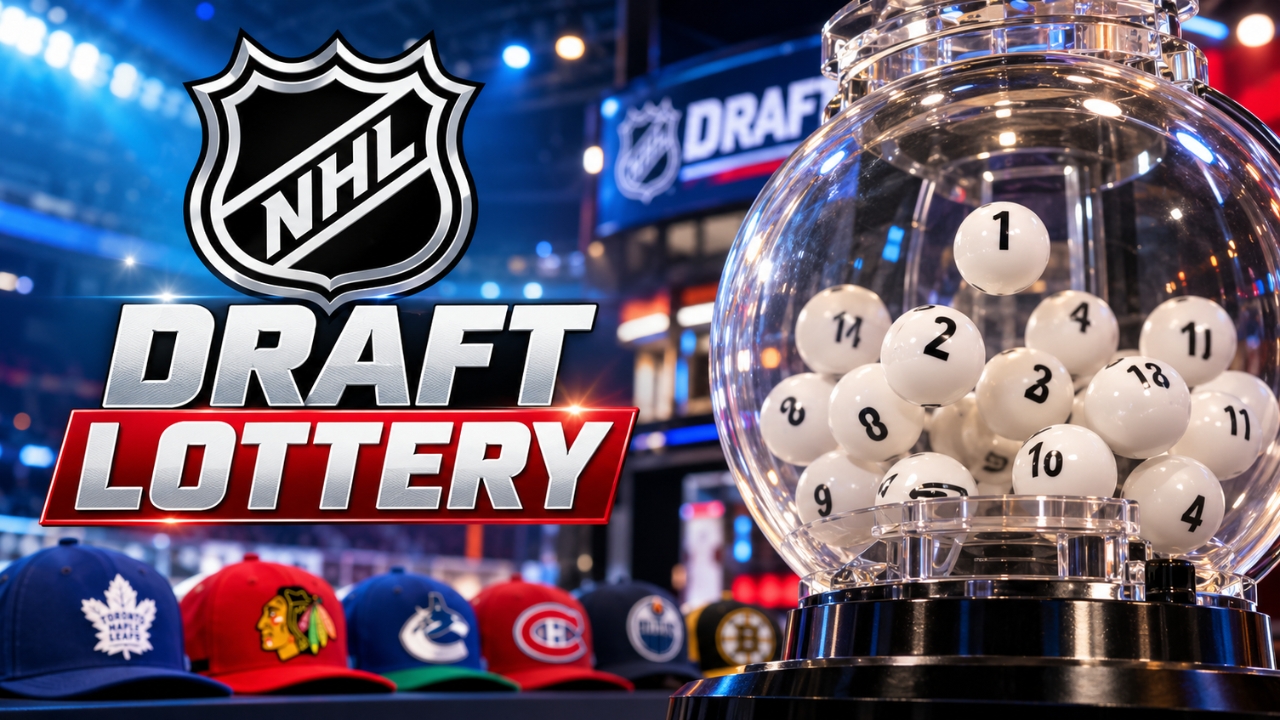
The NHL Draft Lottery can look complicated when the ping-pong balls start flying, but the basic idea is straightforward: the teams that miss the Stanley Cup Playoffs are given weighted chances to move up in the first-round draft order.
The worse a team finishes in the regular season, the better its odds generally are. However, finishing last does not guarantee the No. 1 pick.
Here’s how the NHL Draft Lottery actually works.
Who Is Eligible for the NHL Draft Lottery?
The lottery involves the 16 teams that do not qualify for the Stanley Cup Playoffs. If a team has traded its first-round pick, the team that owns that pick participates in the lottery instead.
The lottery determines the order of the first 16 selections in the first round. Picks No. 17 through No. 32 are later determined based largely on playoff results and regular-season records.
Why Do Bad Teams Get Better Odds?
The NHL uses weighted lottery odds to give teams with fewer regular-season points a greater chance of winning.
Think of it as giving each team a certain number of lottery tickets.
For example, in the 2026 lottery, the team with the fewest points had 185 combinations out of 1,000, giving it an 18.5% chance of winning the first draw. The second team had 135 combinations, or 13.5%.
That means the team at the bottom has the best chance—but still isn’t guaranteed to win.
How Do the Lottery Balls Work?
The NHL uses 14 numbered balls to create four-number combinations.
There are 1,001 possible four-number combinations. One combination is designated as a redraw, leaving 1,000 active combinations that are distributed among the 16 lottery participants according to their assigned odds.
Each team receives a predetermined number of those combinations.
So, a team with 185 combinations effectively has 185 chances among the 1,000 active combinations.
There Are Two Lottery Draws
One of the most important things to understand is that the NHL Draft Lottery isn’t simply one drawing.
There are two separate draws:
- The first draw determines the No. 1 overall pick.
- The second draw determines the No. 2 overall pick.
After the first draw, the remaining teams’ odds are adjusted proportionally for the second draw.
If the same team wins both drawings, the NHL conducts another draw rather than allowing that team to receive both of the top selections.
How Far Can a Team Move Up?
The NHL places a limit on how much a team can move up through the lottery.
A team can move up a maximum of 10 spots.
Because of that rule, only the top 11 lottery positions can potentially win the No. 1 overall selection. The teams initially ranked 12th through 16th cannot jump all the way to No. 1.
This prevents a team that finished relatively high among the non-playoff clubs from making an enormous jump.
What Happens If a Lower Team Wins?
Suppose the team with the 12th-best lottery position wins a drawing.
Because it cannot move up more than 10 spots, it wouldn’t be able to take the No. 1 pick. Instead, the pick would be assigned according to the lottery rules, and the teams above it would shift accordingly.
This is why the NHL Draft Lottery can produce surprising results without completely abandoning the draft order based on regular-season performance.
What Happens to the Remaining Picks?
Once the two lottery draws are completed, the other non-playoff teams are placed into the remaining spots among Picks 1 through 16.
The teams that weren’t selected in the lottery are generally ordered in inverse order of regular-season points—meaning the team with fewer points gets the higher remaining selection.
The playoff teams then occupy Picks 17 through 32 based on how far they advance and their regular-season records.
A Real Example: The 2026 NHL Draft Lottery
The 2026 lottery illustrates how the system works.
The Vancouver Canucks entered the lottery with the best odds at 18.5%, followed by the Chicago Blackhawks at 13.5% and the New York Rangers at 11.5%.
However, the lottery did not simply award the first pick to the team with the highest odds.
The Toronto Maple Leafs ultimately won the 2026 lottery and received the No. 1 overall selection.
That is the key point of the system: odds are not guarantees.
Why Doesn’t the NHL Just Give the Worst Team the First Pick?
The lottery is designed to balance two goals.
First, the NHL wants struggling teams to have a meaningful opportunity to acquire elite young talent. At the same time, the league doesn’t want teams to have an incentive to deliberately lose games simply to guarantee the first selection.
A weighted lottery creates uncertainty.
A team with the worst record has the best odds, but another team can still jump ahead.
Is the NHL Draft Lottery Completely Random?
The actual drawing is random, but the overall system isn’t an equal-chance lottery.
The NHL first determines each team’s position and corresponding odds based on the regular-season standings and the league’s lottery rules. Those odds determine how many four-number combinations each team receives.
So there are really two elements:
- Standings determine the odds
- The lottery drawing determines the winner
Why the Draft Lottery Matters So Much
The difference between picking first and picking several spots later can be enormous.
The No. 1 selection gives a team the first opportunity to choose from the year’s draft class, which can potentially provide a franchise-changing player.
That’s why the NHL Draft Lottery attracts so much attention from rebuilding teams and their fans. A few minutes of lottery drawings can dramatically change the future direction of a franchise.
The Bottom Line
The NHL Draft Lottery is essentially a weighted lottery for the first 16 picks.
The basic process is:
- The 16 non-playoff teams enter the lottery.
- Teams receive different odds based on their regular-season results.
- Four numbered balls create one of the assigned combinations.
- The first drawing determines the No. 1 pick.
- A second drawing determines the No. 2 pick.
- Teams can move up a maximum of 10 spots.
- The remaining lottery selections are filled according to the NHL’s draft-order rules.
- Playoff teams are then placed into the later first-round selections.
So, while finishing near the bottom gives a team a better chance at the top pick, there is never a guarantee that the team with the worst record will pick first. That’s what makes the NHL Draft Lottery so unpredictable—and so important for rebuilding franchises.